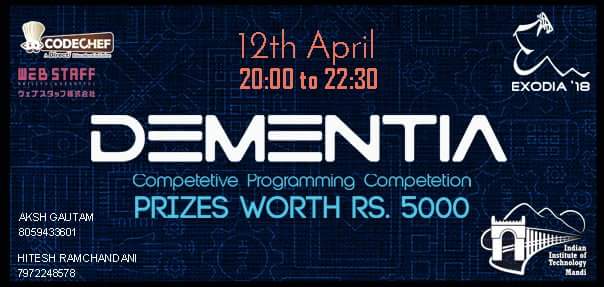
Programming club, Indian Institute of Technology, Mandi is hosting Dementia '18 as part of our cultural-cum-technical fest Exodia. The contest will take place on 12th April,2018 at 20:00 IST. The contest features 6 delectable problems of varying difficulty and you’ll get 2.5 hours for solving them.
The problemsetters and testers for the contest are me(@avi224) and Hitesh(@hitman_coder). The contest is rated for division II on codechef(below 1800 rating). However, division I can participate out of competition and be eligible for prizes.
There are prizes worth Rs 5K(only for Indian participants).
What if someone gets into division 1 after this contest? Will he participate in long as division 1? He might already have solved problems in division 2.
Ratings for Long Challenge, Dementia and upcoming rated contest Coder’s Legacy 2018 will be calculated one after the other. Therefore, first the ratings for long challenge will be calculated. Thereafter, based on that rating, the ratings for Dementia will increase/decrease. Ratings of any contest are calculated among the participants of that contest.
What was the intended solution for sum of ceil in range problem( CodeChef: Practical coding for everyone )
I saw few people got accepted simply by adding ceil value in L to R range for every query, probably with complexity O(Q*(R-L)). What it intended to pass? Is there a better solution present?
No, it was a result of poor testing on our side. The solution is based on math and binary search.
The trick is that for any x, there are atmost O(sqrt(x)) distinct values of ceil(x/A_i) possible, and we can count the frequency of these distinct values between L and R using a mergesort tree.
The editorial will be put soon.