i agree
4 Likes
I liked how you submitted your single source BFS code to prove that it won’t work.
6 Likes
Thanks! I am glad you are following the series.
Here are the updates:
-
I solved another CSES problem: Lava Flow and Multisource BFS
- YouTube -
Introduction to Trees, Binary Trees, Min/Max Heaps, Flattening a Tree into a Vector
- YouTube -
I made an introductory video 00 to make things even simpler
- YouTube -
I am reuploading the solution to the first problem, for greater audio clarity and better explanation/presentation
- YouTube
7 Likes
Today I will try and share Dijkstra theory while solving the next CSES problem.
7 Likes
Language dependent or independent videos ?
2 Likes
I explain concepts in English. But my implementation is in C++, I explain every critical aspect of code though. Just check it out, you’ll like it.
5 Likes
This video series is really helpful! I am really excited about this series and will keep posting updates to support you. I just finished the first two videos. Nice explanation of BFS and DFS on the grid.
1 Like
Thanks a lot for you effort and hard work. It is really helpful for the coding comminity.
1 Like
Thank you guys. Please subscribe! Its a humble request. Will post more videos soon.
3 Likes
Hey please try to make a few more videos on Dijkstra algo, with some interesting problems
1 Like
Done with Dijkstra:: 09 Graph Theory:: Dijkstra's Algorithm with CSES 08 Shortest Routes I (1671) - YouTube
Do give feedback, please!
5 Likes
I updated the Dijkstra’s with more information/explanation/simulation/demonstration! 
3 Likes
I will be adding Bellman-Ford and solving more problems starting tomorrow.
You guys can expect a lot more Dijkstra variants too
Please keep following this series to improve your understanding of graph theory.
1 Like
Hey, can you help me with this problem?
Check out my DFS
void dfs(int u)
{
	for(idx[u]; idx[u] < g[u].size(); idx[u]++)
	{
		int v = g[u][idx[u]];
		int x = u;
		int y = v;
		if(x > y)
		{
			swap(x,y);
		}
		if(edge[x].find(y) == edge[x].end()) continue;

		edge[x].erase(y);
		--degree[u];
		--degree[v];
		dfs(v);
	}
	stck.push(u);
}
See what i did there? I created a global vector idx and did the following to track the edge being currently explored.
for(idx[u]; idx[u] < g[u].size(); idx[u]++)
When I come back, I don’t start checking ALL neighbours of vertex ‘u’. I simply continue from where I left. Hope that makes sense?
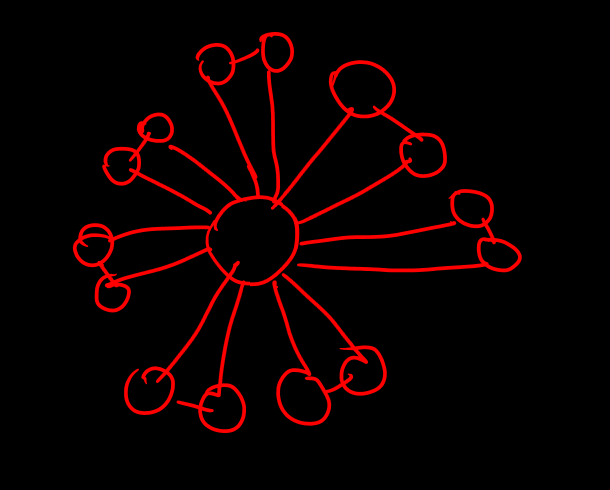
If we don’t take care of this, we will search ALL edges every time in the following case. I am calling this graph a flower-with-petal graph. Only seven petals in this graph, but imagine what happens if there are 10^5 petals (with O(N^2) complexity)
If it doesn’t I am not going to type out more here. I try to make a Eulerian Circuit video on priority and explain this aspect clearly.
Watch out for this video series: - YouTube
1 Like
One can also follow this
1 Like
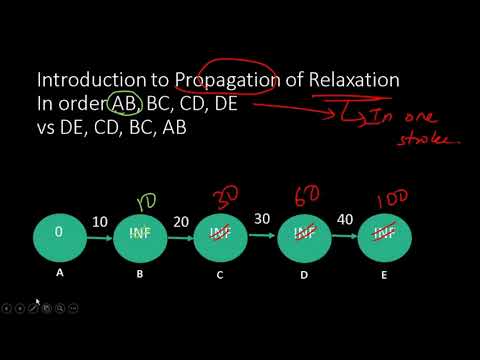
Hey guys! Just solved another problem for you guys: High Score and this time we study the “Bellman-Ford” Algorithm.
Hope you’ll love it.
3 Likes
one of the best graph theory tutorial is by Code N Code
1 Like
Floyd-Warshall being uploaded soon! Catch up fast, guys!
2 Likes
There is nothing in youtube that is as good as this channel when it comes to graph theory.
thank you.
1 Like